MobileCity
An Efficient Framework for Large-Scale Urban Behavior Simulation
Abstract
Generative agents offer promising capabilities for simulating realistic urban behaviors. However, existing methods often rely on static profiles, oversimplified behavioral logic, and synchronous inference pipelines that hinder scalability. We present MobileCity, a lightweight generative-agent framework for city-scale simulation powered by cognitively-grounded generative agents. Each agent acts based on its needs, habits, and obligations, evolving over time. Agents are initialized from survey-based demographic data and navigate a realistic multimodal transportation network spanning multiple types of vehicles. To achieve scalability, we introduce asynchronous batched LLM inference during action selection and a low-token communication mechanism. Experiments with 4,000 agents demonstrate that MobileCity generates more human-like urban dynamics than baselines while maintaining high computational efficiency.
Key Results
at City Scale
vs. Baselines
(Walk, PMV, Bus)
(Maslow's Hierarchy)
Overview
MobileCity is a scalable generative-agent simulator built on a tile-based city representation. Agents are initialized with survey-based demographic profiles and evolve according to dynamic internal states through three modules: needs, habits, and obligations governing compulsory tasks. The framework incorporates a multi-modal transportation system and integrates environmental factors such as weather and temperature.
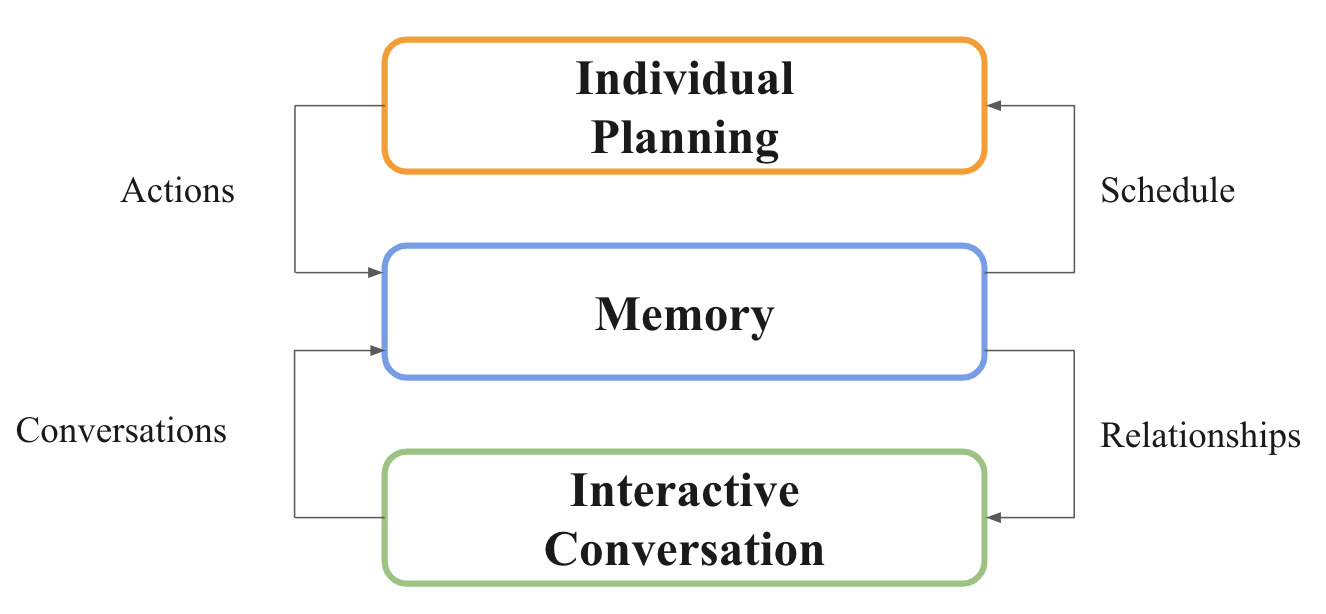
Figure 1: The agent architecture in MobileCity, featuring needs-driven, habit-driven, and obligation-driven action modules that work together to generate realistic urban behaviors.
Agent Behavior Modules
Human decisions arise from three psychological mechanisms. MobileCity formalizes them into separate modules:
Needs-Driven Action
Agents maintain 8 needs following Maslow's hierarchy: Fullness, Energy, Health, Financial Security, Pleasure, Social Connection, Status Recognition, and Self-Growth. Each need decays over time and influences action selection.
Habit-Driven Action
Actions triggered by temporal or spatial regularities reinforced through repetition. Habits are modeled using Gaussian distributions on a circular time representation with Ebbinghaus forgetting curves.
Obligation-Driven Action
Mandatory tasks encoded as core time slots from questionnaire surveys, including sleep schedules, work hours, and family obligations that constrain voluntary actions.
Scalability Mechanisms
To enable efficient simulation at city scale, MobileCity introduces three key strategies:
- Token Reduction: Converting free-form LLM responses into discrete action selection with multiple-choice prompts
- Asynchronous Batching: Independent agent clocks with batched LLM inference for action selection and communication
- Event-Level Logging: Recording only state changes in OpenSearch, with linear interpolation for visualization
Experiments
Runtime Analysis
We compare runtime under different acceleration settings (R = Token Reduction, A = Asynchronous Mechanism, D = Data Logging):
| Population | R Only (s) | R+D (s) | R+A+D (s) |
|---|---|---|---|
| 40 | 194 | 115 | 39 |
| 400 | 2,093 | 1,329 | 383 |
| 4,000 | 22,432 | 15,234 | 3,734 |
Urban Crowd Distribution
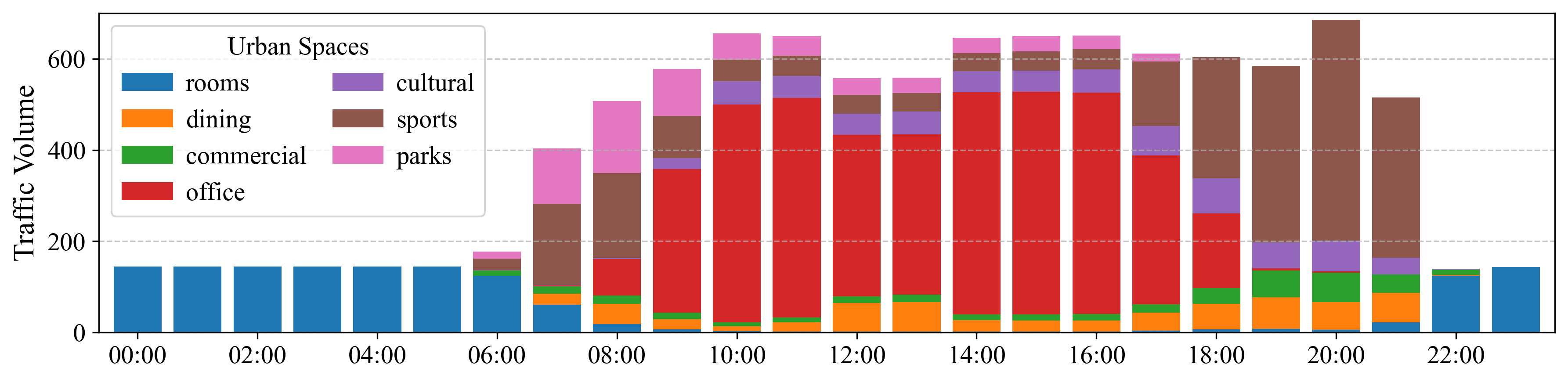
Figure 2: Crowd distribution across different urban venues on weekdays. The simulation captures realistic patterns such as morning commutes, lunch breaks, and evening leisure activities.
Agent Need Dynamics
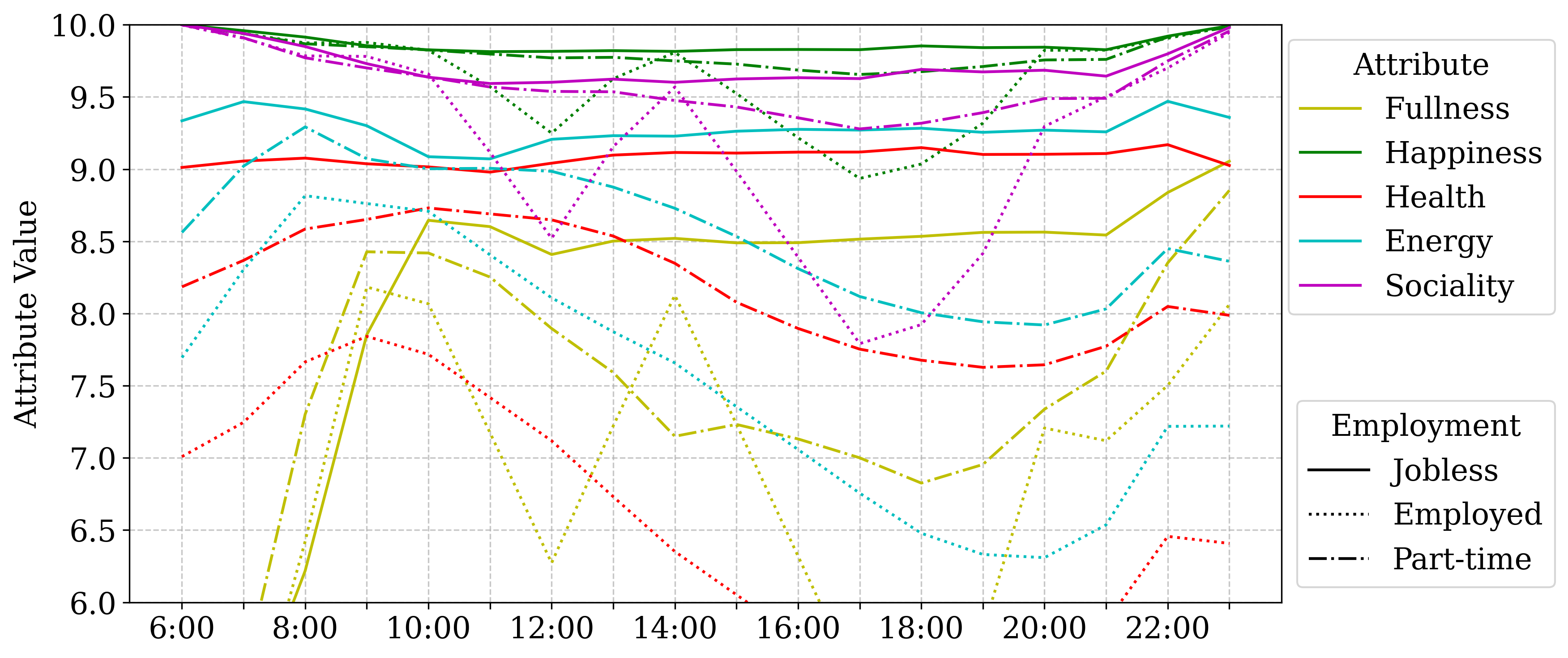
Figure 3: Daily fluctuation of agent needs (Fullness, Happiness, Health, Energy, Sociality) across different employment statuses. Employed agents show characteristic dips during work hours, while jobless agents maintain more stable need levels.