CitySim
Modeling Urban Behaviors and City Dynamics with Large-Scale LLM-Driven Agent Simulation
Abstract
Modeling human behavior in urban environments is fundamental for social science, behavioral studies, and urban planning. Prior work often rely on rigid, hand-crafted rules, limiting their ability to simulate nuanced intentions, plans, and adaptive behaviors. Addressing these challenges, we envision an urban simulator (CitySim), capitalizing on breakthroughs in human-level intelligence exhibited by large language models. In CitySim, agents generate realistic daily schedules using a recursive value-driven approach that balances mandatory activities, personal habits, and situational factors. To enable long-term, lifelike simulations, we endow agents with beliefs, long-term goals, and spatial memory for navigation. CitySim exhibits closer alignment with real humans than prior work, both at micro and macro levels. Additionally, we conduct insightful experiments by modeling tens of thousands of agents and evaluating their collective behaviors under various real-world scenarios, including estimating crowd density, predicting place popularity, and assessing well-being.
Key Results
(vs. 0.28 AgentSociety)
Human Preferences
Tokyo Metropolitan
Correlation (Spearman)
Overview
CitySim is a scalable city simulation framework empowered by LLMs. Agents autonomously generate daily schedules and long-term plans through a recursive, value-driven planning process that balances mandatory activities, personal habits, and situational context. Each agent is equipped with spatial and temporal memories, enabling them to recall past experiences, form and update beliefs about places, and adapt their future decisions accordingly.
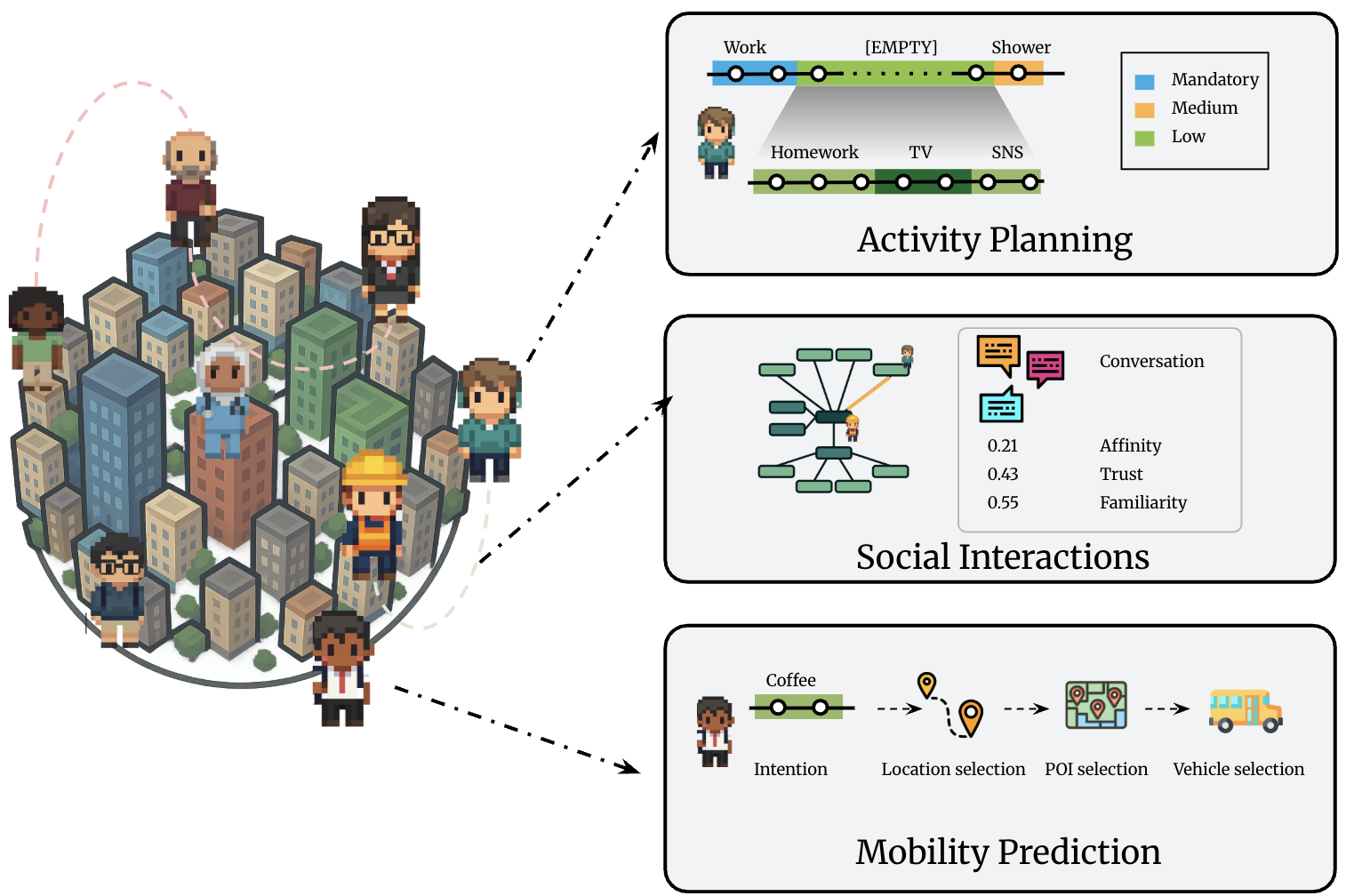
Figure 1: Overview of CitySim: LLM-based agents with diverse personas plan daily activities, interact socially, and navigate a virtual city environment through Activity Planning, Social Interactions, and Mobility Prediction modules.
Agent Architecture
CitySim agents are equipped with advanced cognitive representations for realistic urban behavior:
Persona Module
Includes demographic attributes, spatial anchors (home/work), Big Five personality traits, and empirically-derived habits and preferences from real-world surveys.
Memory Module
Comprises temporal memory (chronological events), reflective memory (thoughts and attitudes), and spatial memory (beliefs about POIs updated via Kalman filtering).
Needs & Goals System
Tracks basic needs (hunger, energy, social) and long-term goals that evolve based on experiences. Needs decay over time and influence activity selection.
Value-Driven Planning
Recursive planning approach that assigns importance scores to activities, balancing mandatory tasks, personal habits, and situational context for realistic schedules.
Experiments
Pairwise Human Preferences
GPT-4o compared anonymized daily routines using naturalness, coherence, and plausibility criteria. CitySim achieves the highest win rate:
| Method | Avg Win Rate | vs. AgentSociety | vs. MobileCity |
|---|---|---|---|
| GeAn | 0.21 | 0.18 | 0.24 |
| HumanoidAgent | 0.28 | 0.31 | 0.29 |
| AgentSociety | 0.42 | - | 0.48 |
| MobileCity | 0.39 | 0.52 | - |
| CitySim | 0.61 | 0.67 | 0.64 |
Well-being Prediction
We assess CitySim's ability to estimate population well-being using a proprietary survey dataset:
| Method | F1-macro |
|---|---|
| GeAn | 0.19 |
| AGA | 0.20 |
| HumanoidAgent | 0.22 |
| MobileCity | 0.21 |
| AgentSociety | 0.28 |
| CitySim | 0.36 |
| GBDT (Upper Bound) | 0.45 |
Crowd Density Modeling
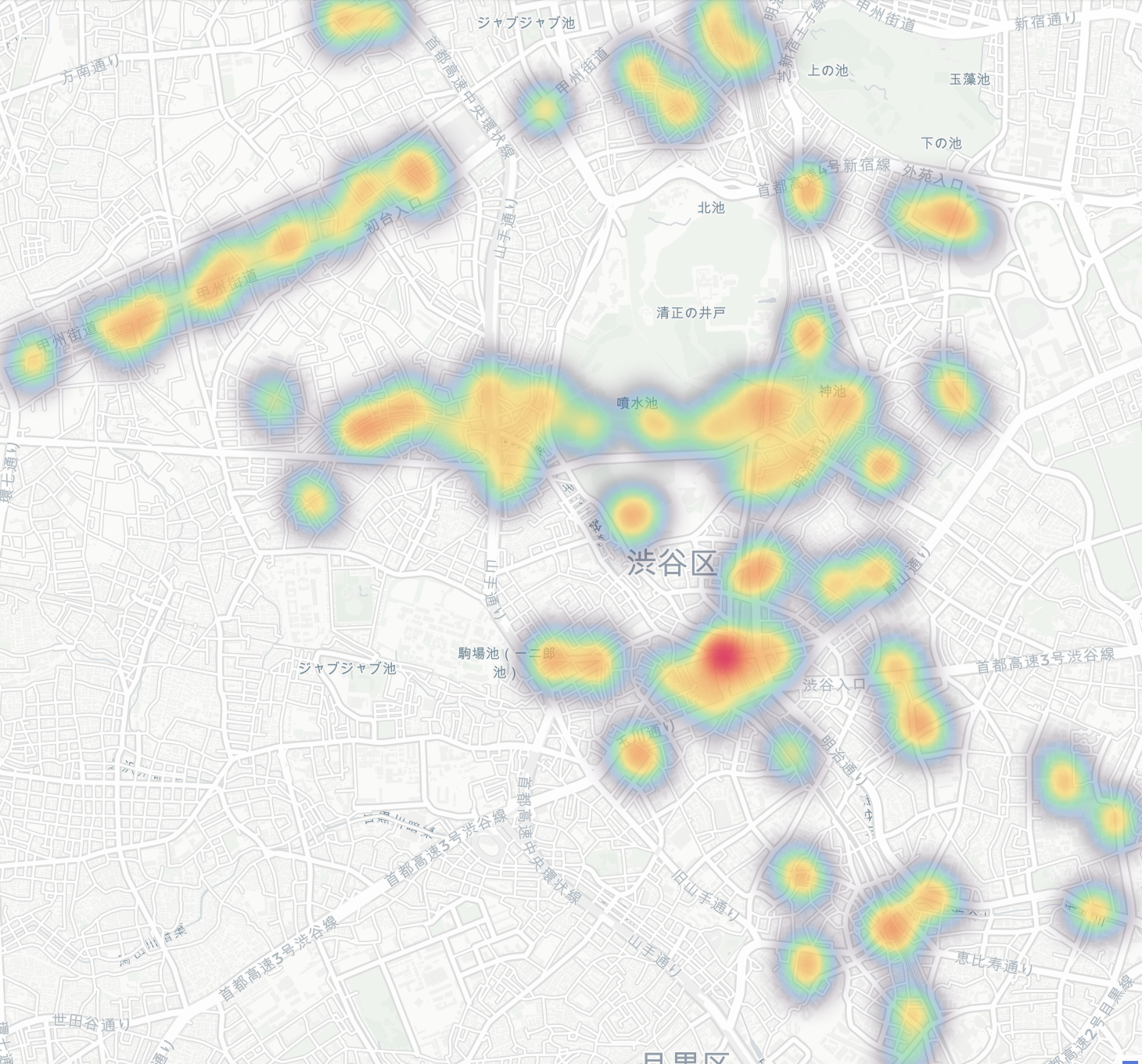
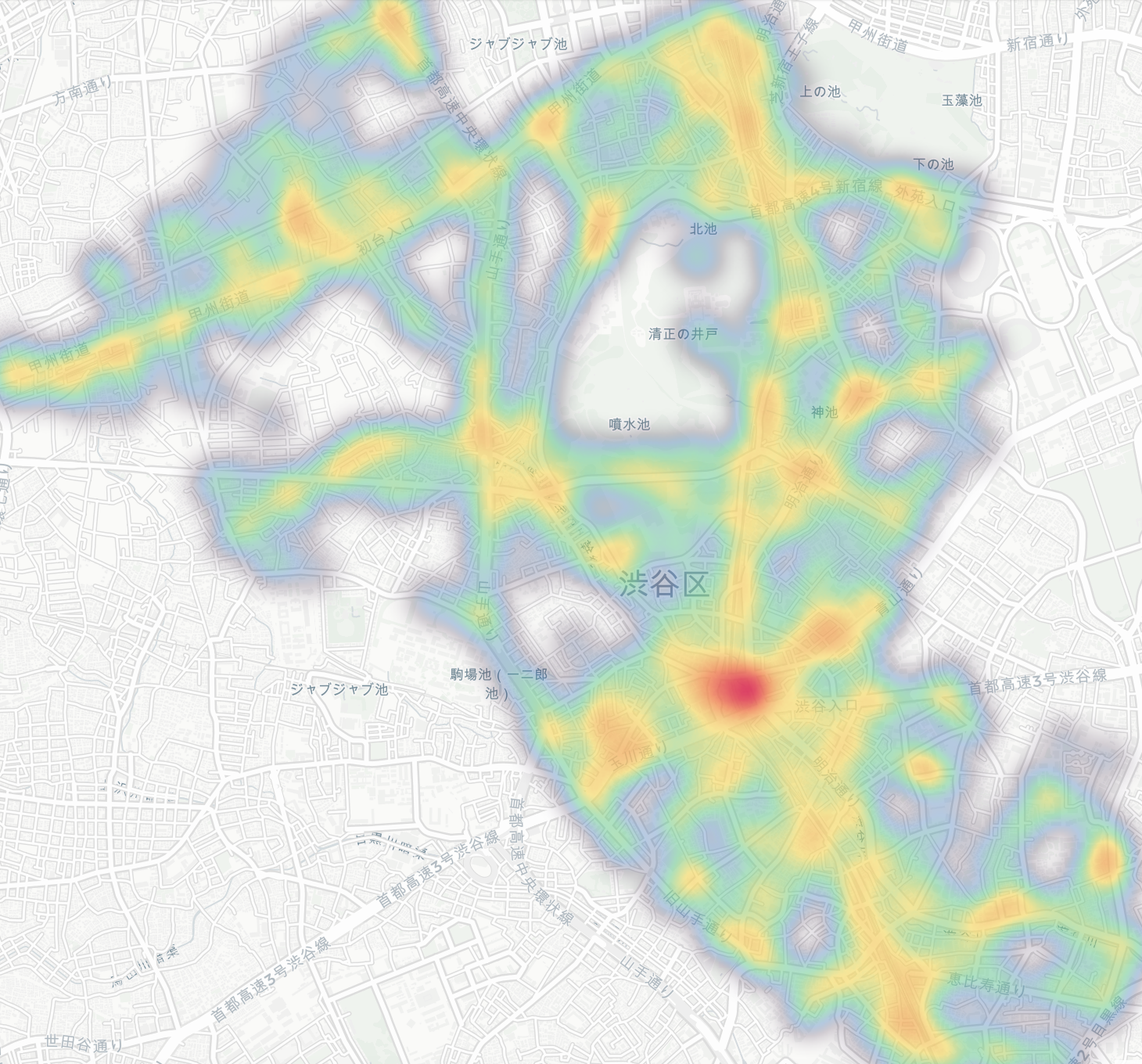
Figure 2: Comparison of simulated (left) and real-world (right) crowd density heatmaps in Shibuya, Tokyo. CitySim accurately reproduces mobility patterns with highest densities around central transit nodes and major commercial streets.
Applications
- Urban Planning: Simulate crowd flows and identify congestion points
- POI Popularity Prediction: Forecast which locations will attract visitors
- Well-being Assessment: Estimate population well-being from simulated behaviors
- Policy Testing: A/B testing of urban interventions in simulation
- Event Management: Plan for crowd density during events