CityReal
Human-Aligned Urban Behavior and City Dynamics Simulation with Large-Scale LLM Agents
Abstract
Large-scale urban simulation plays a pivotal role in social science, traffic safety, and transportation policy. Recent work has shown that large language models, when prompted as agents, can generate lifelike daily routines at city scale. Yet these methods typically rely on few-shot prompting, causing agents to reproduce the LLM's behavioral priors rather than the target population. We introduce CityReal, a modular framework for human-aligned urban simulation. CityReal models agents as intention-driven decision makers that pursue coherent mobility and activity plans rather than isolated step-by-step choices. They adapt over time by learning habits and preferences based on experience and constraints. To improve population-level realism, we learn textual adapters for behavior modules that align agent decisions with observed population statistics. Experiments show that CityReal improves alignment with real-world human behavior at both micro and macro levels. Scaling to tens of thousands of agents, it supports analysis of crowd density, place popularity, mobility flows, and well-being under different urban scenarios, offering a scalable testbed for urban simulation and forecasting.
Key Results
(vs. 0.38 CitySim)
Human Preferences
(GPT-5, 1–5 scale)
Tokyo Metropolitan
Overview
CityReal is a modular framework for simulating urban populations whose behavior is both coherent at the individual level and aligned with observed human patterns. Each resident is an LLM agent embedded in a graph-structured city. Agents follow a perception–decision–reflection loop: they perceive the environment, retrieve relevant memories, continue or revise their behavior around persistent intentions, and update habits, preferences, and beliefs through end-of-day reflection. Before simulation, a calibration stage learns textual adapters that steer behavior modules toward target population statistics while keeping the LLM frozen.
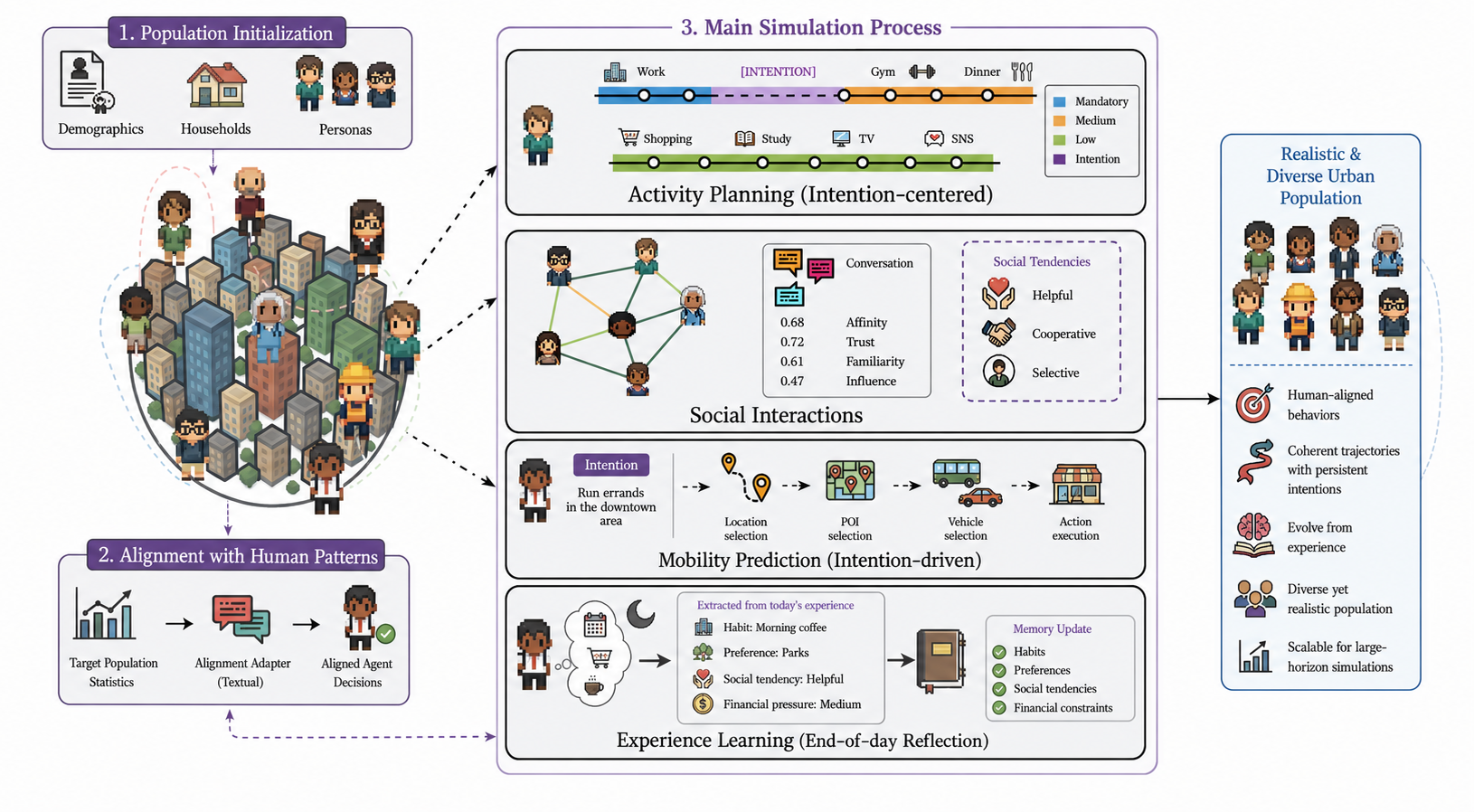
Figure 1: Overview of CityReal. Agents are initialized from population demographics, calibrated to human patterns via textual adapters, and simulated through intention-centered activity planning, social interactions, intention-driven mobility, and experience-driven reflection — yielding a realistic and diverse urban population.
Agent Architecture
CityReal equips each agent with cognitive modules for coherent, human-aligned urban behavior:
Persona & Multi-Store Memory
Demographic attributes, spatial anchors (home, workplace, school), and psychographic traits, paired with temporal, spatial (place beliefs), and reflective memory. A financial-pressure signal derived from income, spending, and budget shapes activity, destination, and transport choices.
Intention-Centered Planning & Mobility
Recursive block-based daily planning assigns mandatory and routine activities, while flexible blocks are driven by persistent natural-language intentions that keep motives stable across steps. A two-stage area→POI selector with a belief-aware gravity model and cost-aware transport choice governs movement.
Population-Level Alignment (MCTS Adapters)
Short textual adapters attached to behavior modules are discovered via Monte Carlo Tree Search, steering agent decisions toward target population statistics while the LLM stays frozen. Plausibility and diversity penalties prevent agents from collapsing into unrealistic or homogeneous behavior.
Experience-Driven Reflection
At the end of each simulated day, agents distill their experiences into reusable behavioral insights — habits, preferences, social tendencies, and constraints — which are consolidated into reflective memory and retrieved to guide future decisions.
Experiments
All agents are powered by GPT-5.4-mini, with 3,000 agents simulated in the Tokyo metropolitan area (scaling to tens of thousands). We compare CityReal against GeAn, AGA, HumanoidAgent, AgentSociety, MobileCity, and CitySim.
Pairwise Human Preferences
Anonymized daily routines are normalized with Llama-3.1 70B and judged by GPT-5 along naturalness, coherence, and plausibility. CityReal attains the highest average win rate across all pairwise comparisons, and the ranking is preserved under a Gemini-3.5 evaluator from a different model family.
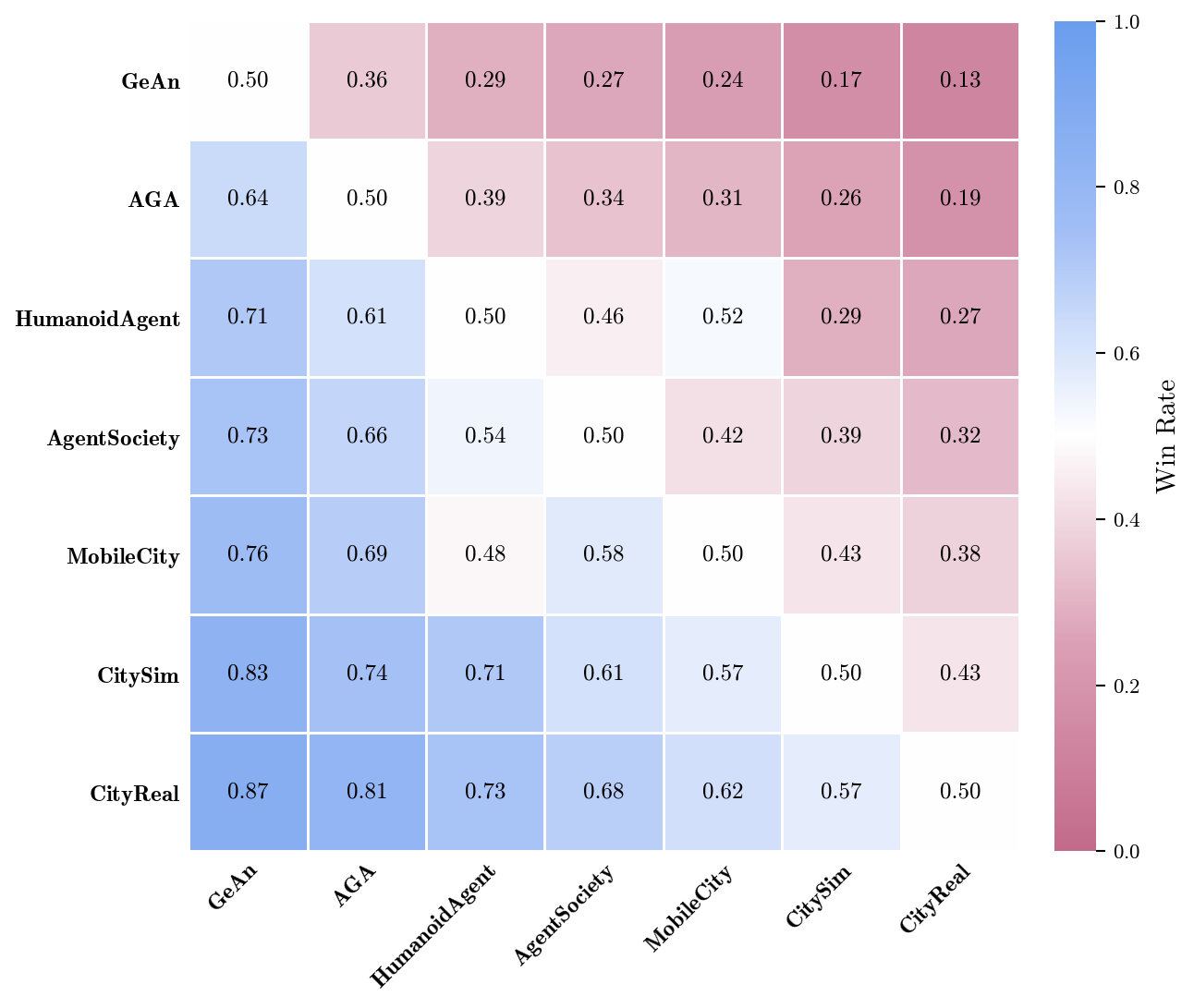
Figure 2: Pairwise win-rate matrix. Each cell is the fraction of trials in which the row method is judged more human-like than the column method. CityReal wins every matchup, including 0.57 against CitySim.
Well-being Prediction
Agents matched to real respondents answer a proprietary well-being survey (1,200 responses, Japan; 5 classes) after simulating three weeks of activity. CityReal leads all agent-based methods, approaching an XGBoost model trained directly on real activity data.
| Method | F1-macro |
|---|---|
| GeAn | 0.20 |
| AGA | 0.21 |
| MobileCity | 0.22 |
| HumanoidAgent | 0.24 |
| AgentSociety | 0.29 |
| CitySim | 0.38 |
| CityReal | 0.43 |
| XGBoost (Upper Bound) | 0.45 |
POI Popularity
Simulated visit counts in Shibuya, Tokyo are compared against real-world popularity (Google Maps ratings) via Spearman rank correlation. Population-level alignment sharply improves correlation across every category, driven in part by explicit financial constraints that diversify visits across income groups.
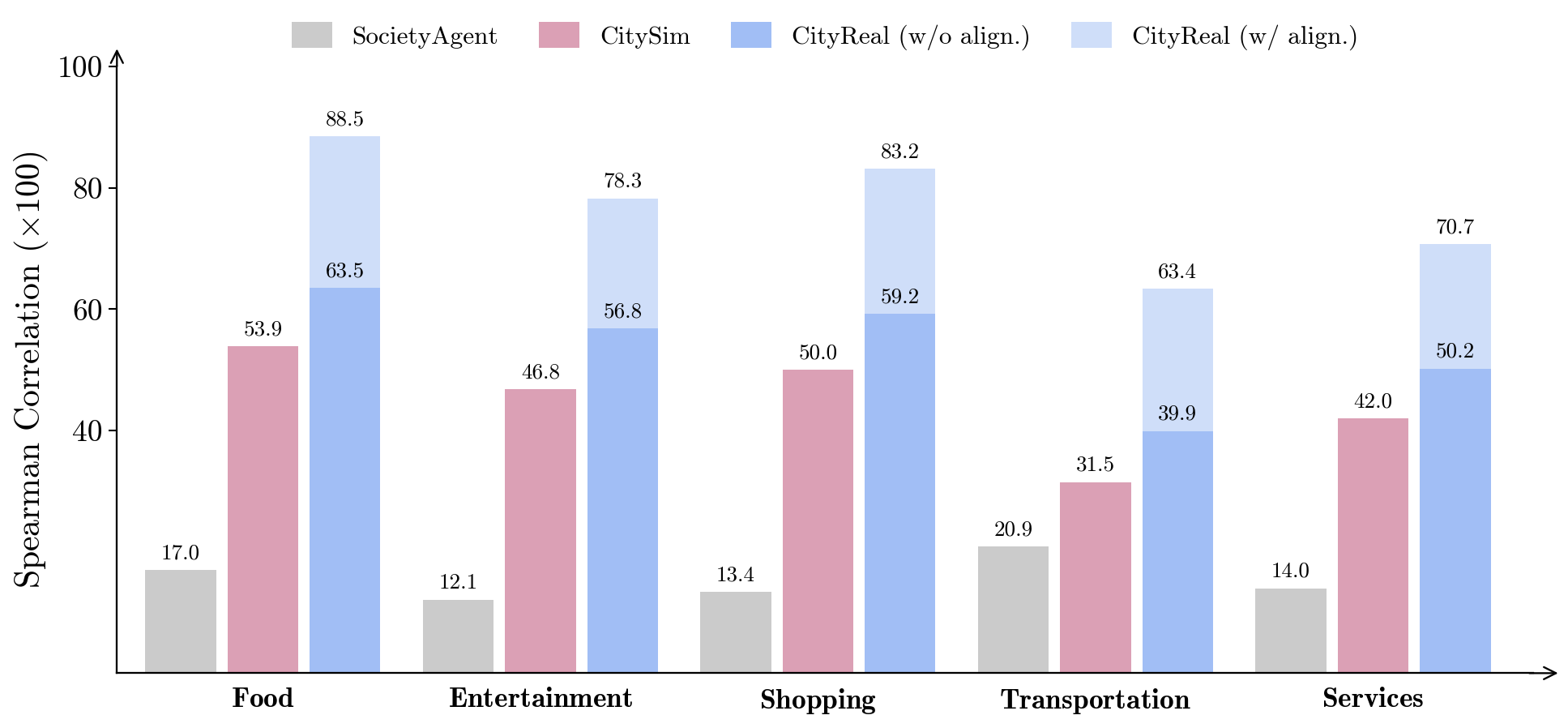
Figure 3: POI popularity correlation (Spearman ×100) by category. CityReal with alignment reaches up to 0.89 (Food), substantially above CitySim and the unaligned variant.
Modeling Crowd Density
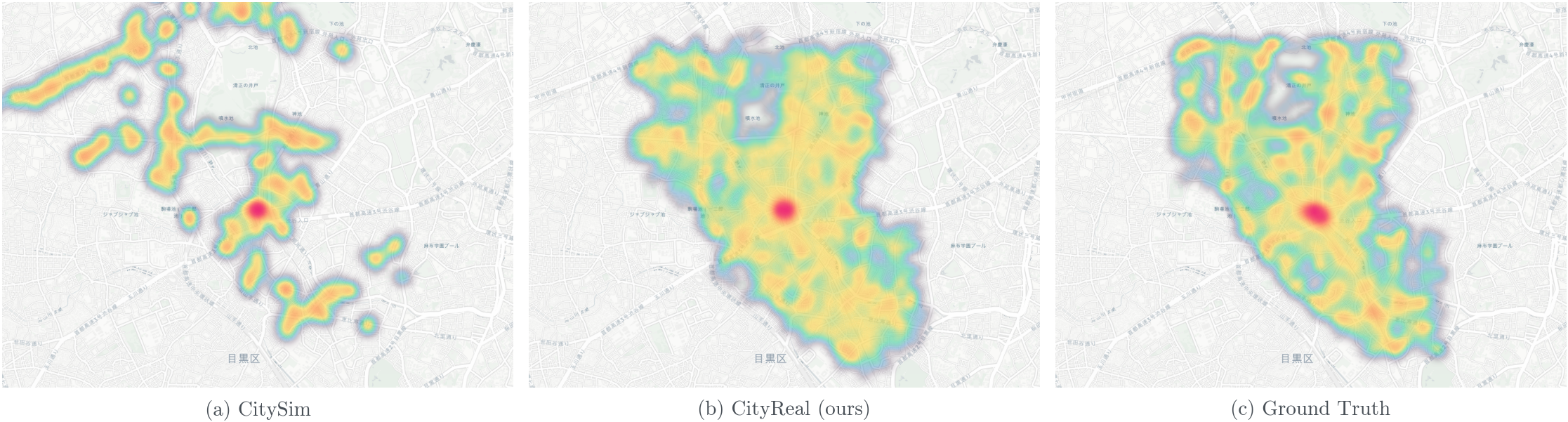
Figure 4: Crowd density in Shibuya, Tokyo: CitySim (left), CityReal (center), and ground truth from smartphone location data (right). CityReal closely reproduces real concentrations around the train station and major commercial streets.
Applications
- Urban Planning: Simulate crowd flows and identify congestion around stations and commercial areas
- POI Popularity Forecasting: Predict which locations attract visitors for retail and event strategy
- Well-being Assessment: Estimate population well-being from simulated behavior as a scalable survey complement
- Policy A/B Testing: Run counterfactual scenarios (e.g., weather or interventions) on the same population
- Mobility & Travel Analysis: Reproduce commute peaks and leisure travel patterns at city scale